
AI implementation + software delivery
Find the gap.Build the system.
We work inside your business, find where the work stalls, then build what should exist next.
AI built around your business. Deployed on your terms.
Illustration of an example operation: work moves between five tools, one hand-off is done by hand, and a queue builds up there until it is marked as the gap.
Your business already runs on a system.
We sit with the people doing the work and trace every hand-off until the place where work waits is obvious.
We don’t prescribe AI before we understand the work.
A trace walks every path in the operation and labels it; the hand-off from the inbox to the spreadsheet is done by hand and marked as the gap.
Then we decide what should exist.
Automate it, connect it, build it, add AI, replace it, or leave it alone. The work picks the tool, and sometimes the right answer is not AI.
Here: connect the inbox to the spreadsheet and automate the intake. The calendar and invoicing already work, so they stay as they are.
Six options appear around the gap. Replacing the tools, building a new app and adding AI are rejected; connecting and automating are chosen; the calendar and invoices are left alone.
Then we close the gap.
AI where it earns its place, software everywhere else. The decision becomes a working system wired into your inbox, your spreadsheet and your calendar. Nothing you rely on gets ripped out.
What we buildThe chosen options move into the gap, which becomes a wireframe, then an intake component connected to the inbox and the spreadsheet; the queue drains and the tangled paths straighten into one flow.
Deployed where your data should live.
Your cloud, your hardware, or both. We choose per system and say what each option supports before you commit.
Runs inside your chosen cloud account, under the controls you configure.
A boundary appears around the built system to show where it runs: on your devices, inside your own cloud account, on a public cloud, or split between your devices and the cloud.
Then it runs, and you can watch it run.
Work moves on its own. Uncertain cases stop for a person. Every step is logged, so anyone can check what happened and why.
Live log of the example
The whole operation runs: every tool shows a working status, one invoice question stops at an approval step for a person, then continues.
MAS-AI product
We don’t just draw this. We build it.
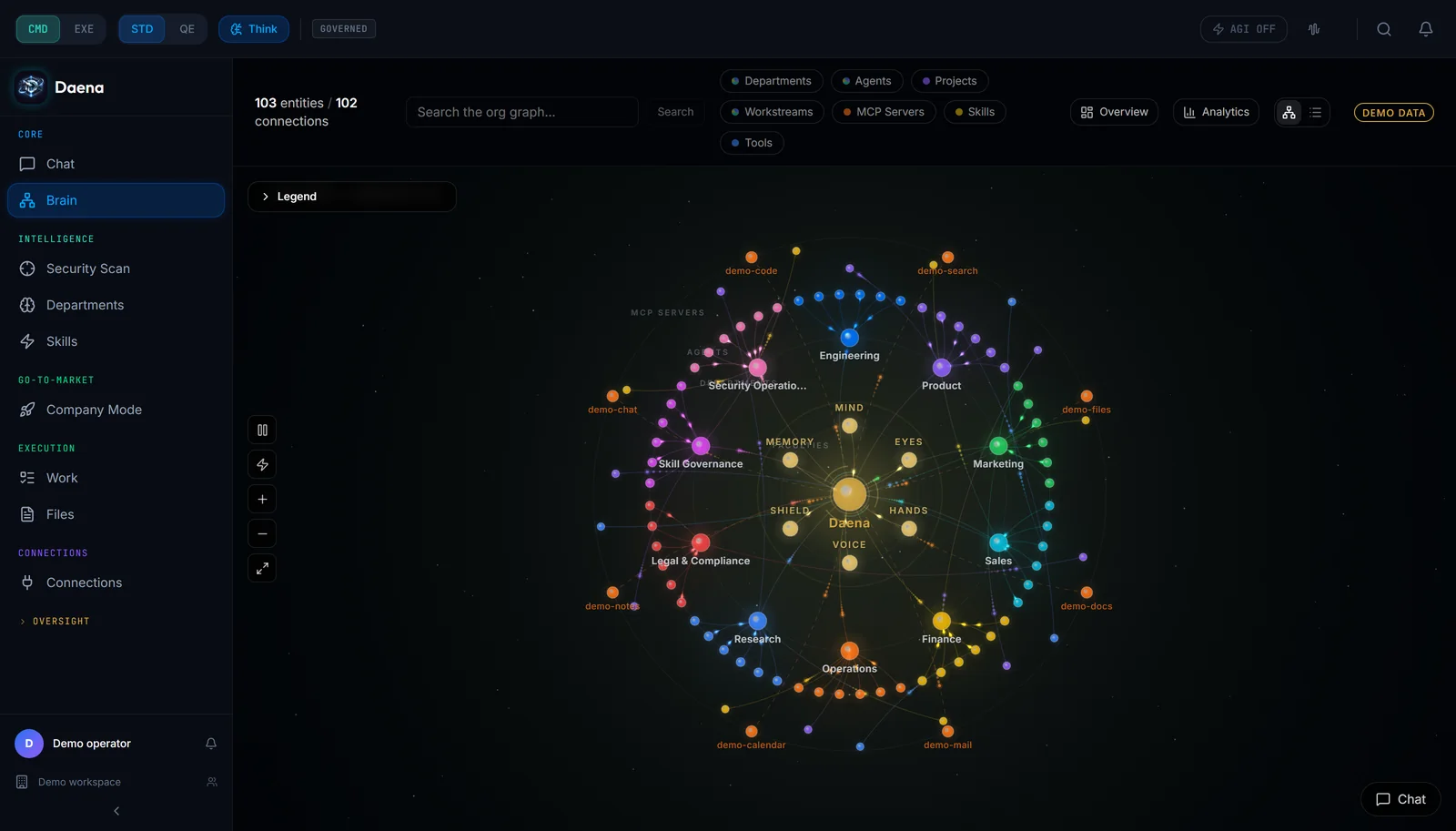
Daena is our governed multi-agent platform: 10 department agents, 6 capabilities each, under 9 hard laws.
Daena Brain with demo data. Screenshot, September 2026.
Daena Brain view with demo data: the governance core, its six capabilities, ten departments such as Engineering, Finance and Legal and Compliance, their agents and demo tool servers, drawn as a network.
What we build depends on the gap.
One method, different answers. Pick one to see how the same operation changes.
A model where it earns its place: answers from your own documents, drafts a person approves, decisions with a trail.
OpenAI, Anthropic, Gemini, Grok or open-weight models · retrieval · document extraction and OCR · evaluation
All servicesSystems we have built.
The problem first, what we engineered second. Each entry says what it is today: a system we operate, an open-source release, or research.
Daena
Agent frameworks make it easy to let a model act. They make it hard to know what it did, why, on whose authority, and to stop it before an irreversible step.
A governed multi-agent platform: AI departments that plan and act inside approval gates and an audit trail.
ragX
A retrieval system that always answers will sometimes answer from nothing. For internal knowledge, a confident wrong answer costs more than no answer.
Our retrieval engine: answers from our own documents with citations, and a verifier that makes it abstain when the sources do not support a claim.
MCP Switchboard
Connecting AI assistants to business tools means one configuration per tool per assistant, secrets scattered in config files, and no record of what the assistant did.
One governed endpoint that brings many MCP tool servers to Claude and ChatGPT, with an encrypted vault, per-tool policy, approvals and an audit log.
Our product websites
A technical offer is hard to judge from a page of claims. A buyer who is not an engineer needs to see the work happen, and a site that only describes it leaves the first step to email.
mas-ai.co, daena.mas-ai.co and kya.mas-ai.co: designed, written, built and deployed in-house.
Founder-led from diagnosis through delivery.
The person who maps your business is the person who designs and builds the system. No handoff to a team you have not met.
Masoud MasooriFounder and CEO, MAS-AI Technologies Inc.
About the companyYou own it
The code, the data and the accounts are yours, as set out in the contract.
Scope first
A fixed scope and price before any build starts.
People approve
AI never takes an irreversible action without a person.
Handover
Documentation and a walkthrough your team can run with.
- Patent application
- Neural-Backed Memory Fabric (NBMF), US provisional patent application 64/020,421
- Programs
- Google for Startups Cloud Program, Microsoft for Startups
Questions
Do you only build AI?
No. We build whatever closes the gap: automation, custom software, websites, and AI where it earns its place. Sometimes the right answer is a well-built form and an integration, and we will say so.
We do not know what we need yet. Is that a problem?
That is the normal starting point. The Build Blueprint maps how your business runs and ends in a written plan with a clear build or no-build recommendation.
Can it work with the tools we already use?
Usually, yes. We connect to the systems you already run, such as your CRM, inbox, calendar, spreadsheets and databases, rather than replacing them.
Can our data stay private?
Yes, when the whole system is designed for it. Models can run on your own servers, in your cloud account or in a hybrid setup, and we check every part that could send data out: the model, embeddings, connectors, telemetry, logs and backups. You get a written record of what stays where before you commit.
Can it run on our own hardware?
Often, yes. We can assess the hardware you have, or help you size, source, install and configure new equipment as a scoped piece of work. The right size depends on the model, how many people use it at once, the speed you need, and the cost to run and maintain it. Equipment is bought separately; we do not supply it from stock.
Do we have to use Daena or your other products?
No. Daena, ragX and our other products show what we can build. Your system is built around your tools and your requirements, and nothing ties you to a product of ours.
Who owns the code?
You do, as set out in the contract. Code, data and accounts are yours, and every build ends with documentation and a handover.
Who will I work with?
MAS-AI is founder-led. The founder maps your business, designs the system and leads the build.