What worries people

  • “We are shipping an AI feature and nobody has reviewed it.”

    A security review of the feature and the application around it: inputs, outputs, tools, secrets and data paths.

  • “How do we know the AI is giving good answers?”

    An evaluation set built from your real cases, run before launch and after every change.

  • “If it does something wrong, can we find out why?”

    Audit trails: what was asked, what the system did, which tool it used and who approved it.

  • “Can the agent do more than it should?”

    Least-privilege access per tool and per role, with approval on anything that cannot be undone.

  • “Our keys are sitting in config files.”

    Secrets moved into a vault, scoped, rotated and kept out of prompts and logs.

What we do

Six pieces of work. You can take one, or all of them as part of a build.

  1. Security reviews of apps and AI features

    A threat model and review of prompts, tools, data flows, authentication and dependencies. Findings are ranked and fixes proposed.

  2. Evaluation against real examples

    Test sets drawn from your cases, scored for accuracy and for correct refusal, and rerun on every change.

  3. Audit trails and traceability

    Structured logs of each request, tool call and decision, retained under rules you set.

  4. Human approval steps

    Approval queues for actions that spend money, send messages or change records, each with a named owner.

  5. Least privilege

    Narrow permissions per tool, per agent and per user, so a mistake or a misuse has a small reach.

  6. Secrets handling

    Vaulted credentials, scoped tokens, rotation and redaction, so secrets do not travel in prompts or logs.

What you receive

  • A written report: scope, method, findings ranked by impact and what to fix first.
  • Fixes for the findings inside our scope, or precise change instructions for your developers.
  • The evaluation set and the scripts to rerun it.
  • An audit-log design and, where we build it, the implementation.
  • Approval and permission rules written in plain language.
  • A retest of the fixed findings.

Does it connect to what we already use?

Yes. Controls only get used when they sit inside your existing flow, so we build them into it.

  • Identity provider and single sign-on
  • Secret managers
  • Logging and monitoring
  • CI pipelines
  • Ticketing for findings
  • Code repositories
  • Cloud accounts

We work from access you grant, scoped to the systems in scope. Nothing outside that scope is touched.

Where it applies

Reviews and controls follow the system wherever it runs. What changes is who owns each risk.

  1. On your devices

    Fits, with limits

    Data stays on the machine, which removes the risk of transit. Logging and approval need a plan, because there is no central server to hold them.

  2. On your servers

    Fits

    You own patching, network rules and log retention. We review the deployment and the model-serving layer with you.

  3. Private cloud

    Fits

    Identity, keys and network segmentation live in your account. We review the configuration as well as the code.

  4. Hybrid

    Fits

    The boundary between local and cloud is the main risk. We check what crosses it and that each crossing is logged.

  5. Cloud

    Fits

    Provider terms, retention settings and shared-responsibility limits matter most. We read them with you and record what is assumed.

How it is built

For technical readers: what we choose from. The choice is made per system, from your data, your constraints and your workload.

Evaluation
Test sets, adversarial prompts and regression checks around the AI you run.
Controls
Approval steps, least-privilege access for AI components, and secrets in a managed vault.
Records
Audit logs and traces of what each AI component did and on whose authority.
Monitoring
Alerts on failures, cost and quality drift, with a rehearsed rollback.

Governance we build into our own systems

We name clients only with their written permission. These are systems we run, and the controls are part of how they work.

System we operate

Daena

Klyntar, the security layer inside Daena: a scan workflow, evidence checkpoints and a gate that rejects a serious finding with no evidence chain.

Beta, with access on request at daena.mas-ai.co. It is the reference architecture we draw on for governed agent builds.

Read the case study
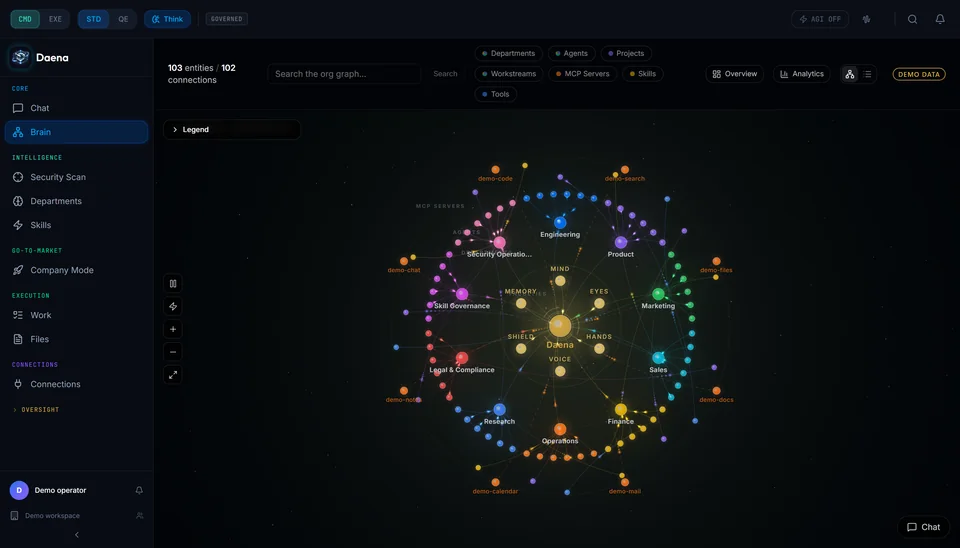
Daena Brain view with demo data: the governance core, its six capabilities, ten departments such as Engineering, Finance and Legal and Compliance, their agents and demo tool servers, drawn as a network.
  • MCP Switchboard

    An encrypted vault, per-tool policy, an approval gate and an audit log for AI access to your tools.

    Open sourceRead the case study
  • AI Company OS

    Deterministic checks decide when work is done, and every verdict is logged.

    System we operateRead the case study
  • KYA Mission Control

    Research: bounded authority, budget stops and signed receipts that anyone can verify offline.

    R&DRead the case study

Questions we get

What does a security review of an AI feature cover?

The feature and what surrounds it: how input reaches the model, what the model can call, what it can return, where secrets and data live, and how access is checked. AI-specific issues such as prompt injection sit alongside ordinary application security.

Can you guarantee the system is secure?

No, and be wary of anyone who says yes. A review lowers risk and shows what remains, and the retest confirms the fixes. It is not a proof.

How do you evaluate AI output?

We collect real cases from your work, agree what a good answer looks like, and score the system against them, including cases where the right behaviour is to refuse or hand off. The set is rerun on every change.

Where do people stay in the loop?

Wherever an action is hard to undo: spending, sending, deleting, changing a record of truth. We set the approval rule by risk and log each approval.

Can you work with our security team?

Yes, and it goes better that way. We share scope, method and findings with them, and write the report so that it can go into your risk process.

Do you help with compliance?

We help produce the technical evidence that compliance work asks for: logging, oversight and documentation. We are not a law firm and we do not give legal advice. For the EU AI Act, see the readiness page.

Bring us the system you want checked.

We start with the problem, then tell you whether it is worth building.

Bring us a bottleneck