
System we operate
Daena
A multi-tenant Python and FastAPI platform with a React front end, in beta.
Beta, with access on request at daena.mas-ai.co. It is the reference architecture we draw on for governed agent builds.
Read the case study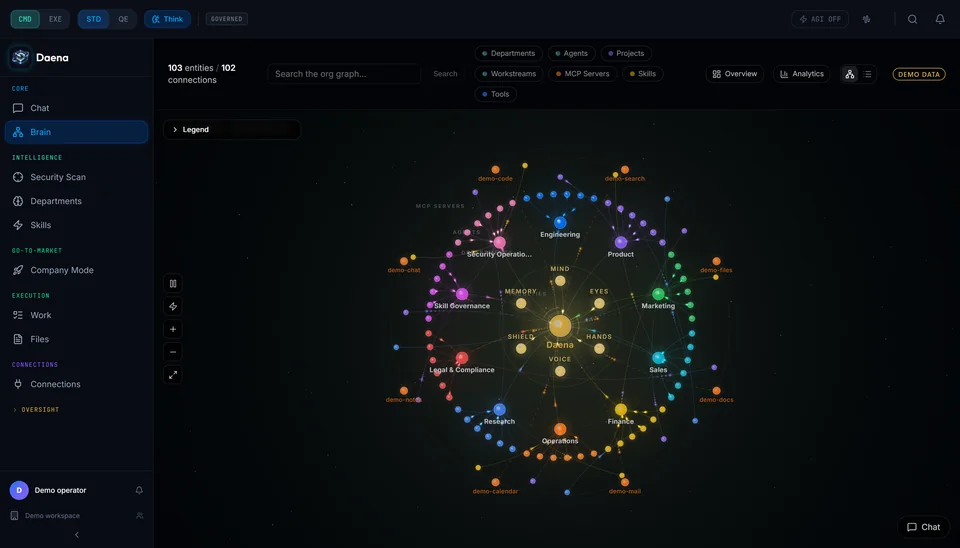
When a product on the shelf almost fits, the gap costs you every day. We build the web app, internal tool or API that fits your process, and connect it to the systems around it.
“We run the business on spreadsheets and they are breaking.”
An internal tool with the same logic, proper access control, a history of changes and reports that come from live data.
“No product on the market does exactly this.”
We build the specific thing and only the specific thing, so you do not pay for a platform you will not use.
“Our systems do not talk to each other.”
An integration layer of APIs and scheduled sync, with checks that flag records that do not match.
“We want AI in our product but do not know where it belongs.”
We add it at the points where it removes work, behind an interface your users already understand, with evaluation so you can see that it works.
“We are launching a product and need it engineered, not prototyped.”
Product engineering from data model to deployment. Multi-tenant if you need it, tested, and deployable by your own team.
Six kinds of work, from a single internal tool to a full product.
Applications your customers or staff use in the browser: accounts, roles, workflows and payments where they are needed.
Replace the spreadsheet with forms, approvals, reports and dashboards over your live data.
From data model to launch: multi-tenant architecture, billing hooks, admin, monitoring and the deploy pipeline.
Backends and APIs, asynchronous where it helps, typed and documented so other systems can rely on them.
Search, drafting, classification or an assistant added to a product you already run, with evaluation and a fallback for when the model is unsure.
Connectors and sync jobs between your CRM, accounting, inbox and database, with retries and mismatch alerts.
Yes. Nearly every custom system we build sits beside existing ones, so integration is part of the design from the first week.
Where a system exposes only exports or a screen and no API, we say what that costs in reliability before we build on it.
Most software can run anywhere. What changes is who operates it and how it scales.
Fits, with limits
Desktop or local-first tools for one user or one office. Multi-user software with shared data needs a server.
Fits
On your servers or virtual machines, packaged in containers and documented for your IT team.
Fits
In your own cloud account, so billing, access and data residency stay yours.
Fits
Core system in one place and specific services in another, for example a local database with a cloud email service.
Fits
The default for most products: managed hosting, quick to scale, standard monitoring.
For technical readers: what we choose from. The choice is made per system, from your data, your constraints and your workload.
We do not publish client work. These are products we built and operate, at different stages of maturity.
A multi-tenant Python and FastAPI platform with a React front end, in beta.
Beta, with access on request at daena.mas-ai.co. It is the reference architecture we draw on for governed agent builds.
Read the case studyA TypeScript product released as open source: dashboard, command line, encrypted vault and audit log.
Open sourceRead the case studyResearch stage: signed receipts, an offline verifier and an interactive demo, in Python and TypeScript.
R&DRead the case studyBuy when a product covers most of the process and you can live with the rest. Build when the process is your advantage, when no product fits, or when the glue between products costs more than the software would. We tell you which it is, including when the answer is to buy.
Yes. The code, the data and the accounts are yours, as set out in the contract. The handover includes documentation so another developer can take it on.
Python and FastAPI for backends, TypeScript and React for front ends, SQL databases and containers for deployment. Where you already have a stack, we follow it.
Yes. We work in your repository, follow your conventions and hand over in a form your team can maintain. If you have no developers, we write it so the next person you hire can maintain it.
We agree a scope in writing before the build. A change is priced before it is made, so the price does not drift quietly.
Yes. We add it where it removes work, keep it behind the interface your users know, and test its output against real examples. If it is not accurate enough for the job, we tell you and do not ship it.
We start with the problem, then tell you whether it is worth building.
Bring us a bottleneck