
Daena
A governed multi-agent platform: AI departments that plan and act inside approval gates and an audit trail.
The problem
Agent frameworks make it easy to let a model act. They make it hard to know what it did, why, on whose authority, and to stop it before an irreversible step.
What we engineered
Governance has to sit inside the execution path, not beside it. Every request should pass the same staged pipeline, and the risky ones should wait for a person.
- 10 department agents, 6 capabilities each: mind, eyes, hands, voice, shield and memory.
- A ten-stage request pipeline: security gate, session, intent and risk, governance check, cost preflight, model routing, memory recall, request build, streaming, then persist and audit.
- Two action modes: plan-only by default, and execution that goes through the security gate and an approval queue for high-risk actions.
- Tiered memory (5 memory tiers) where unverified content expires and permanent tiers need approval.
- Klyntar, the security layer: scan workflow, evidence checkpoints, a gate that rejects any serious finding without an evidence chain, and a supply-chain scanner.
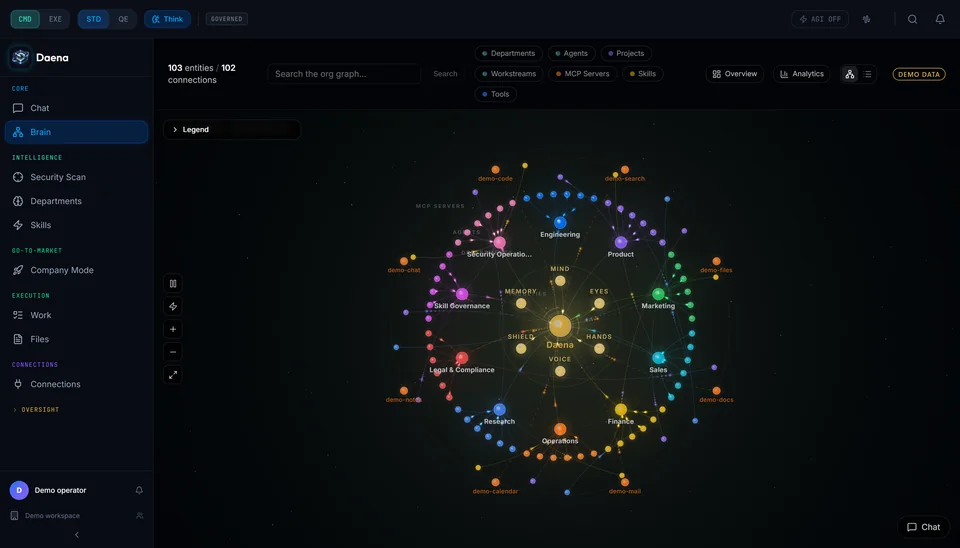
How it connected
Routing across 10 model providers, with local and cloud runtimes as options, and 116 connectors in the catalog.
What technology was appropriate
- Python and FastAPI (async), SQLAlchemy 2, Pydantic v2; React and TypeScript front end.
- 9 hard laws enforced in code; tenant isolation at the database layer.
- Multi-tenant by design; an earlier build runs on Google Cloud Run.
- Source-available under BSL 1.1, public on GitHub.
Where it stands
Beta, with access on request at daena.mas-ai.co. It is the reference architecture we draw on for governed agent builds.
Current state, stated as it is today.
See it yourself
Automate operations
Workflow automation, AI agents and knowledge assistants that take repeated work off your team.
Build software
Custom web apps, internal tools, SaaS products and the APIs that connect them.
Security, evaluation and governance
Security reviews, evaluation, audit trails and human approval where an action matters.
Private, local and cloud AI
Run AI on your devices, your servers, a private cloud or the public cloud, chosen per project.
Bring us the bottleneck.
If your problem looks like one of these, tell us. We will say whether a build is the right answer.
Bring us a bottleneck